Add your promotional text...

Palmaria mollis
Kingdom: Plantae
Subkingdom: Biliphyta
Phylum: Rodophyta (Red Algae)
Subphylum: Eurhodophytina
Class: Florideophyceae
Subclass: Nemaliophycidae
Order: Palmariales
Family: Palmariaceae
Genus: Palmaria
Species: Palmaria mollis
Taxonomy and Classification
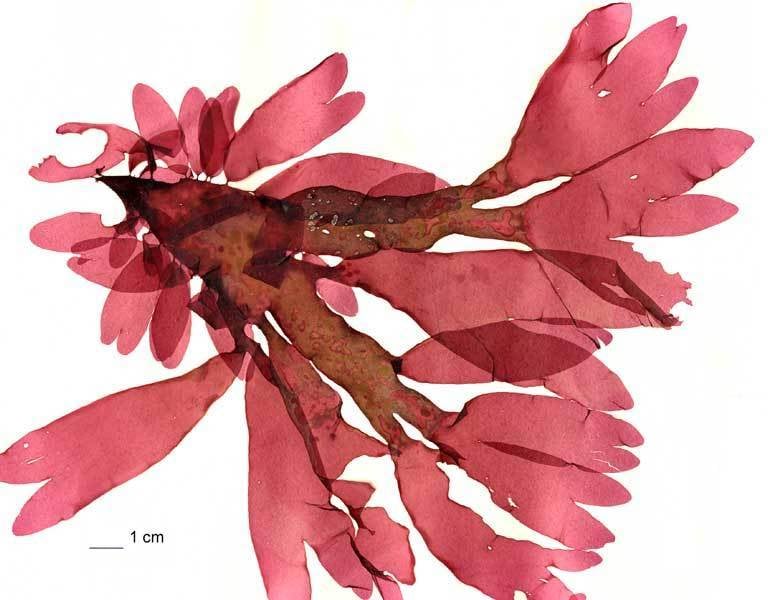
Palmaria mollis, commonly known as “dulse” or “söl”, is a red macro algae that grows in the north coasts of both the Atlantic and Pacific oceans approximately 40° - 80° N (Stévant et al, 2023). Their deeply colored crimson, purple, or reddish-brown fronds grow out into a hand-like shape, with “fingers” extending out from a main “palm” (Maine Coast, n.d.). The fronds are soft and silky feeling, and surprisingly strong for how thin they are. They attach to a thin stipe, which in turn attaches to a hard surface via a disc-shaped holdfast. They can grow about 50 cm (20”) long and 3-8 cm (1”-3”) wide.
Dulse is often said to taste like bacon - which isn’t entirely true! According to the scientist from which that reputation originates, dulse doesn’t so much taste like bacon as it shares the umami characteristics of bacon.
Other Names for P. mollis:
Formerly identified as Palmaria palmata, Palmaria seaweeds have been known by other names throughout history:
Dulse (English)
Duileasc, dillisk, creannach (Gaelic)
Tellesk, terlesk, bezhin saout (cattle's seaweed) (Breton)
Søl, söl (Norwegian/Danish and Icelandic)
Goëmon à vache (French)
Botelho-comprido (Portuguese)
Other Names for P. mollis:
Formerly identified as Palmaria palmata, Palmaria seaweeds have been known by other names throughout history:
Dulse (English)
Duileasc, dillisk, creannach (Gaelic)
Tellesk, terlesk, bezhin saout (cattle's seaweed) (Breton)
Søl, söl (Norwegian/Danish and Icelandic)
Goëmon à vache (French)
Botelho-comprido (Portuguese)
OUR ADDRESS
1600 SW University Plaza
Corvallis, OR